
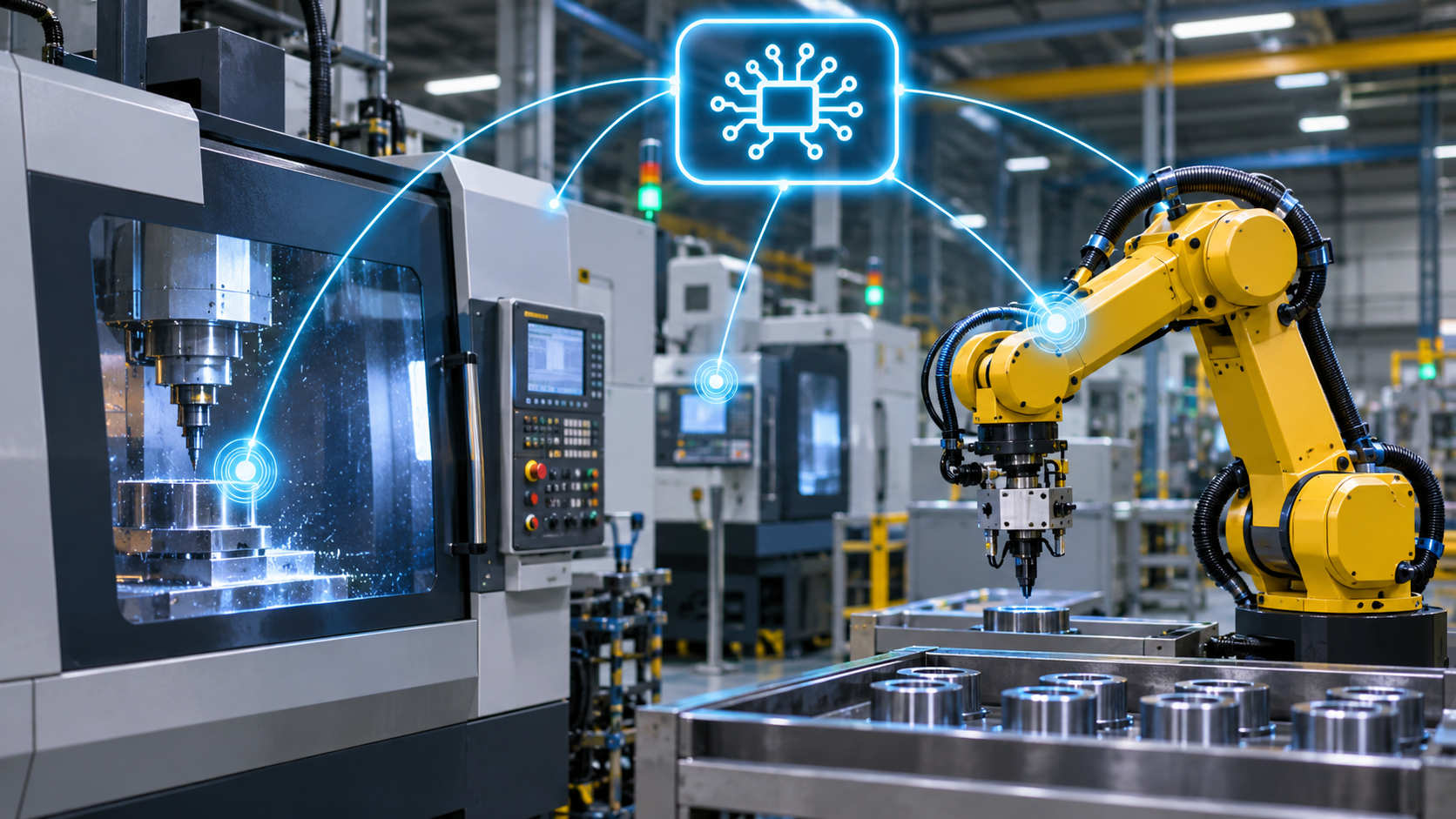
New developments in artificial intelligence could make it easier for manufacturers to connect machines, automate processes, and improve production efficiency.
Most manufacturers are familiar with at least some uses of artificial intelligence (AI). It can help forecast demand, analyze production data, identify defects, and even troubleshoot equipment problems. But what if AI could go a step further by not just analyzing what’s happening on the shop floor, but actually helping operate the equipment? That’s the promise behind a new technology called the Model Hardware Standard (MHS), introduced by AI company Anthropic in August 2026. While still in an early testing phase, the technology could eventually change how manufacturers connect, manage, and automate their equipment.
Making Different Machines Work Together
One of the longstanding challenges in manufacturing is getting different pieces of equipment to communicate. A manufacturer might have a CNC machine from one supplier, an inspection system from another, and a robotic arm from a third. Each may have its own software, operating instructions, and communication requirements. Connecting these systems often requires specialized programming, additional software, and considerable engineering time.
MHS is designed to simplify that process.
Think of it as a universal translator between AI and industrial equipment. Instead of developing a completely different connection for every machine, manufacturers could potentially use a common approach that allows AI systems to understand what equipment can do, read operating information, and issue instructions.
For example, imagine a production operation where AI could:
- Monitor temperatures, operating conditions, and equipment status.
- Coordinate a robotic arm with an inspection system.
- Identify when a process is drifting outside acceptable limits.
- Recommend adjustments—or make approved adjustments automatically.
- Help diagnose equipment problems and suggest corrective actions.
These are potential manufacturing applications, not claims that MHS has already been proven across typical factory production lines.
Early Testing Shows Promise
Anthropic has been working with research organizations and equipment manufacturers to test the technology. In one example, researchers at Genentech connected multiple laboratory instruments, including a robotic arm and specialized testing equipment. AI coordinated the devices, evaluated results, and adjusted operating settings to improve performance. In another demonstration, AI adjusted a laser, checked the results through a camera, and repeated the process until it achieved the desired alignment. These demonstrations are important because they show AI interacting with physical equipment—not simply generating reports or answering questions.
Anthropic reports that its approach can significantly reduce the time required to integrate certain programmable devices, potentially turning projects that previously took weeks into work completed in hours or minutes. However, these results come from early research environments. Manufacturers should not assume the same improvements will be achievable with their existing equipment.
What About Safety?
Allowing AI to control physical equipment raises important questions: “What happens if the AI makes an incorrect decision?”, “What if a machine encounters a problem the AI doesn’t understand?”, “What happens if the connection is interrupted?”
These aren’t hypothetical concerns. During early laboratory testing, AI sometimes struggled to understand physical problems. In one experiment, it repeatedly attempted an operation that was failing because of bubbles in a liquid sample. Human experts had to explain the physical cause and guide the system toward a better solution.
On November 12, 2026, Anthropic updated its usage policies to address AI systems that autonomously control potentially hazardous equipment. The requirements include having a qualified operator who can monitor and stop the equipment, along with provisions for equipment to remain in a safe state if the AI connection is lost.
For manufacturers, the takeaway is clear: AI should complement established machine controls, safety systems, and experienced operators—not replace them.
Manufacturing AI Is Already Moving Beyond the Laboratory
In November 2026, Anthropic introduced another development that could be useful to manufacturers: Claude for Manufacturers. Unlike the experimental Model Hardware Standard, which is intended to help AI communicate with and operate physical equipment, this new offering focuses on helping manufacturing employees complete everyday tasks. For example, an AI assistant could help a quality engineer investigate a defective part by reviewing inspection records, identifying similar past problems, and preparing a corrective-action report for human review. Other applications include equipment troubleshooting, preparing customer quotations, and organizing production information. The distinction is important. AI can already help manufacturers make better use of their information, even if they aren’t ready to connect AI directly to their machines. Meanwhile, companies such as Doosan Robotics and Universal Robots are exploring how MHS could eventually extend those capabilities to physical equipment.
Together, these developments suggest a progression from AI assisting manufacturing personnel to AI helping coordinate increasingly complex production operations with appropriate human oversight and safety controls.
What Should Manufacturers Do Today?
MHS is still a research preview, and most manufacturers won’t be installing it on their production lines tomorrow. But the underlying direction is worth paying attention to.
Manufacturers interested in preparing for this next generation of automation can begin with a few practical steps:
- Understand your equipment’s connectivity. Identify which machines can share operating data or accept instructions through software.
- Look for opportunities to connect existing systems. Equipment monitoring, quality inspection, and production reporting are useful starting points.
- Start with low-risk AI applications. Consider using AI to analyze machine data and recommend improvements before allowing it to make physical changes.
- Involve your operators and engineers. Their understanding of how equipment behaves in real-world conditions is essential.
- Ask equipment suppliers about future capabilities. When purchasing or upgrading machinery, consider whether it supports open communication standards and integration with other systems.
The Bigger Picture: AI Is Moving Onto the Shop Floor
For years, much of the discussion around AI in manufacturing has focused on analyzing data and supporting business decisions. Technologies like MHS point toward a future where AI could also help coordinate the machines and processes that make products. That doesn’t mean fully autonomous factories are right around the corner. Significant work remains in equipment compatibility, reliability, cybersecurity, and safety. But for small and mid-sized manufacturers, the opportunity is worth watching. The companies that begin improving equipment connectivity and building experience with AI today may be better positioned to take advantage of more advanced automation tomorrow.
The goal isn’t to replace manufacturing expertise. It’s to give manufacturers new tools to make better use of their equipment, people, and production capabilities.
Learn More
- Anthropic: Previewing the Model Hardware Standard — August 27, 2026
- Anthropic: 2026 Usage Policy Update — November 12, 2026
- Anthropic: UST Is Bringing Claude to Physical AI — July 9, 2026