
Most manufacturers will tell you the same thing: the work isn’t the hard part, it’s the gathering. Pulling the right drawings, past job costs, inspection reports, and supplier emails together before anyone can make a decision eats a large share of the day. A 2025 Manufacturing Leadership Council survey found that 79% of manufacturers still enter data manually.
On November 12, Anthropic launched Claude for Manufacturing, a plugin built to take on that gathering. It reads your own records, does the legwork, and hands the result to the person responsible to review and approve. Here is what’s in it, what it could mean for a smaller shop, and how it differs from another manufacturing announcement Anthropic made earlier this year.
What Claude for Manufacturing is
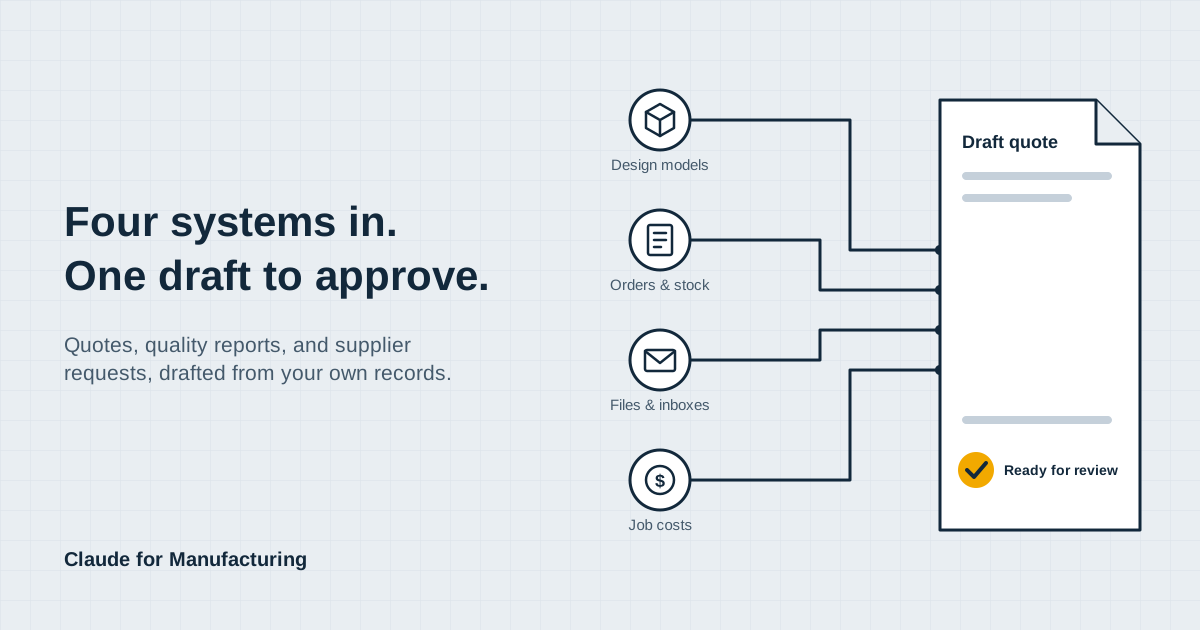
Claude for Manufacturing is a plugin that bundles 17 skills and 4 connectors. The skills cover sales, quality, operations, supply chain, design, and setup. Some handle a single task, while others chain several steps together so Claude can carry a job forward until a person needs to weigh in.
The design principle matters as much as the features: the work is built to end with human review. An estimator checks and releases the quote. A quality engineer verifies the fix before a corrective action report goes out. Claude can also link figures and claims back to the underlying data and documents, so the reviewer can see where a number came from.
The Skills
Anthropic’s announcement highlights six example workflows. The plugin includes 17 skills in total, and Anthropic says it plans to add more over time. Organizations can also build on the existing ones to fit their own operations.
- Quoting a new job. Claude reads a customer’s request, lists what’s missing, compares costs on similar past jobs, and drafts the quote for release.
- Investigating a failed inspection. Claude documents the failure, checks past reports for the same problem, ranks likely causes, and drafts the corrective action report.
- Diagnosing a breakdown. Claude reads sensor exports, repair notes, photos, and the manual, then ranks likely causes for a technician to check.
- Sourcing from another supplier. Claude prepares the request for quotes and compares the bids that come back.
- Comparing designs in Autodesk Fusion. Claude generates variations from an existing model, scores them against the engineer’s targets, and drafts a decision memo.
- Reporting on production. Claude compiles output against target, equipment downtime, and the cost of that downtime into a single report.
The Connectors
The plugin works from your own records through four connectors:
- Autodesk Fusion lets engineers compare more design options by generating variations from an existing model.
- Infor lets buyers and planners check purchase orders and stock before acting.
- Microsoft 365 lets quality engineers pull procedures, supplier emails, and exported reports into one job from shared folders and inboxes.
- Oracle NetSuite lets estimators price new work against real orders, inventory, production steps, and job costs.
Not running one of those systems? Anthropic says you can still use the plugin. Save regular exports from your other systems to Microsoft 365, and Claude works from those files to draft quotes or compile production reports.
One more detail worth knowing: Infor is releasing its own separate plugin. The Infor connector in Claude for Manufacturing is for looking up records. Infor’s plugin goes further and lets teams make changes in Infor from Claude, such as releasing a purchase order to another supplier and rescheduling affected production after a buyer approves. Claude’s access follows the buyer’s existing Infor permissions.
Where small and mid-size manufacturers may see the most value
The following use cases are our read on where the announced skills are likely to matter most for smaller operations, where a handful of people wear many hats.
- Faster, more consistent quoting. In a job shop, the estimator is often the owner or one overstretched employee, and a slow quote can lose the job. Having Claude read the request, flag missing information, and draft a quote from your own cost history can shorten turnaround while keeping a person in charge of the final price.
- Less paperwork around quality problems. When a part fails inspection, the investigation and corrective action report can pull a quality engineer away from the floor for hours. Claude can assemble the history and draft the report so the engineer spends time on the actual fix.
- Capturing know-how that lives in a few heads. Smaller plants often depend on one or two veteran technicians who “just know” why a machine stops. A diagnostic skill that reads repair notes, sensor exports, and manuals helps give newer staff a ranked starting point.
- Handling supplier surprises. When a material shipment slips, a buyer needs to know fast which customer orders are exposed and what alternatives exist. Claude can prepare requests for quotes and compare the responses, and with the Infor plugin can act on the buyer’s approval.
- A weekly production report that writes itself. Plant managers can have output, downtime, and the cost of missed targets compiled into one report, even from exports of systems that don’t have a connector.
- More design options, less rework. For shops using Autodesk Fusion, generating and scoring variations against your targets can widen the options considered before committing to one.
How this differs from the Model Hardware Standard
If you followed Anthropic’s announcement on August 27, you may be wondering how Claude for Manufacturing relates to the Model Hardware Standard (MHS). They are best understood as two different layers, not a first version and a second version.
- Claude for Manufacturing works on information. It drafts quotes, reports, and requests from your business records, and a person approves the result. It does not operate equipment, which Anthropic states directly. It is available now on Team and Enterprise plans.
- MHS works on machines. It is a shared specification that lets AI agents discover, monitor, and operate programmable physical equipment, describing a device’s measurements, settings, and safety limits in a standard way. It is model-agnostic and reachable through standard protocols such as the Model Context Protocol. It opened as a research preview to a first group of scientific labs and advanced manufacturers, with partners including AWS, Genentech, Universal Robots, Doosan Robotics, and QIAGEN. Anthropic plans to open-source it later, but hasn’t announced a date.
In the announcement for Claude for Manufacturing, Anthropic points to MHS as the work it is developing for equipment control. So the relationship is complementary: one helps your people with the paperwork and analysis around production today, while the other explores how AI might one day safely interact with the machines themselves. For most small and mid-size manufacturers, Claude for Manufacturing is the one that’s practical to evaluate right now.
How to get started
- Check your plan. The plugin is available on Claude Team and Enterprise plans.
- Install the plugin and say “Set us up.” Claude asks which systems your team uses, tests the connectors, and reports which skills can’t fully run yet.
- Start with one workflow. Quoting or the weekly production report is a sensible place to begin, since the review step is easy to build into existing habits.
- Join the webinar. Anthropic is hosting a technical webinar on November 17 at 11:00 a.m. ET.
Results will depend on the quality and organization of your records, and every output is a draft for a person to review. Treated that way, it is a promising way to give a small team more time for the decisions only they can make.
Sources: Introducing Claude for Manufacturing (Anthropic, Nov. 12, 2026) and Previewing the Model Hardware Standard (Anthropic, Aug. 27, 2026).